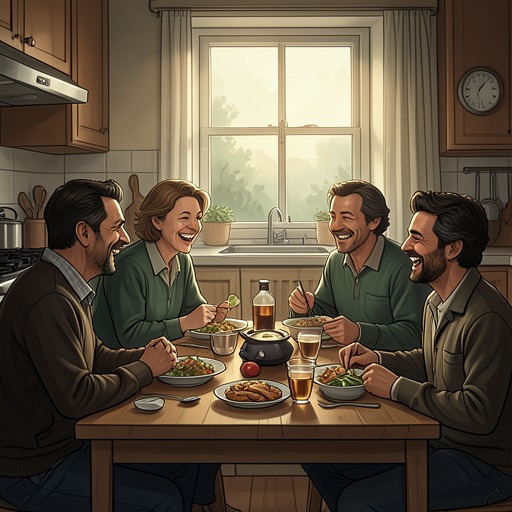
Blanca and Elisa
También esto pasaráBlanca and Elisa’s friendship begins with an immediate sense of recognition and is tested by a painful clash over boundaries, grief, and the meaning of intimacy. They share a taste for wine, irreverence, and wholehearted involvement with other people, yet Elisa’s caution and analysis stand in sharp contrast to Blanca’s appetite for risk and freedom. When Elisa believes Blanca has crossed a line with her boyfriend, Damián, their friendship turns from easy intimacy to accusation; the argument ends with Elisa leaving and Blanca crying.
A Friendship of Immediate Recognition
Blanca first notices Elisa outside their children’s school: eccentric and impeccably dressed, with an appearance that distinguishes her from Blanca’s habitual old jeans and men’s shirts. Their friendship begins with what Blanca understands as an immediate, adolescent-style friendly crush. The recognition is not merely aesthetic. They share tastes and aversions, a fondness for white wine, and a tendency not to take things too seriously.
Blanca also sees a deeper likeness in how they give themselves to the world and to other people: completely. She attributes this shared openness both to passionate, trusting temperaments and to protected childhoods. That affinity gives their friendship its intensity, but it does not make them interchangeable. Their differences are present from the beginning, alongside the common ground.
Different Temperaments, Shared Company
When Blanca announces that she plans to spend a few days in Cadaqués, framing the trip as an invitation to pleasure and excess, Sofía responds enthusiastically. Elisa, by contrast, begins an erudite warning about drugs, Freud, mourning, the maternal figure, and the dangers Blanca might encounter. Blanca’s account makes the contrast pointed: Sofía enjoys the world, while Elisa suffers and analyzes it. The difference is a recurring tension in their friendship, not an absence of care; Elisa’s concern is visible even when Blanca experiences it as excessive interpretation.
They move within an overlapping circle of friends and partners, and sometimes share the practical, noisy settings of family life. On the journey toward Cadaqués, Elisa travels in her own car with Damián, while Blanca’s car is full of children and their demands. Later, at a crowded meal, Elisa and Damián are absorbed in their turbulent relationship, speaking secrets quietly; Elisa rolls cigarettes for him with careful, concentrated gestures. These scenes place the friendship among other intimate bonds, but they also foreshadow the particular sensitivity that Damián will bring to the surface between the two women.
The Goodbye Kiss
After a night spent with friends, Blanca wakes with a severe hangover and is pleased to see Elisa, remarking that they have barely talked since Elisa began dating Damián. Elisa is serious and tired rather than companionably amused by the previous evening. When Blanca asks what is wrong, Elisa identifies the moment that upset her: she saw Blanca say goodnight to Damián.
Blanca initially laughs, assuming Elisa means a different man, then understands that the concern is about Damián. She acknowledges that he kissed her on the mouth as he usually does, but disputes Elisa’s interpretation of the contact: she says their lips merely brushed, that they were very intoxicated, and that they are friends. To reassure Elisa, Blanca promises not to kiss him again. Elisa maintains that the two women’s behavior is flirtation, not simply friendship. Blanca answers with a broader, more permissive understanding of friendship, insisting that flirtation can belong to it. Their disagreement is therefore not only about what happened at goodbye; it is about whether their own casual intimacy can be separated from the claims and limits of a romantic relationship.
Grief, Freedom, and Accusation
The disagreement widens into a dispute about Blanca’s way of living. Elisa rejects what she sees as Blanca’s fantasy of a new social order in which people can understand one another, kiss freely, move in and out of relationships, and have children across shifting arrangements. In Elisa’s view, such freedom works only if other people do not matter. Blanca denies indifference, but Elisa counters that Blanca cares for almost no one apart from her children and perhaps her mother.
Elisa then addresses Blanca’s bereavement directly. She recalls that Blanca’s mother was elderly and very ill, suffered greatly during her final six months, but also had a wonderful life: she loved and was loved, had success, friends, and children, enjoyed herself, and did what she wanted. Elisa recognizes that Blanca loved her mother and is sad and somewhat lost, but argues that grief does not give her the right to turn everyone else’s life upside down. Her intervention is both intimate and accusatory: she treats Blanca’s mourning as real while refusing to accept it as an excuse for behavior that may hurt others.
Blanca responds by attacking Elisa’s fears. She calls her a coward for refusing drugs, not wanting children, and needing a boyfriend beside her, and describes her life as confined. Elisa reverses the charge, invoking Blanca’s financial privilege, her lack of experience in public hospitals, and her complaints about the poorer neighborhoods where Elisa lives. She accuses Blanca of being the one enclosed in an invented fantasy world. The exchange turns their earlier contrast in temperament into a direct contest over whose account of reality is more honest.
Departure and Aftermath
As Elisa crosses the garden, Blanca calls after her that her kisses belong to her and that she will decide with whom to share them. She casts kissing as more widely available—and therefore more democratic, but also more dangerous—than money, and imagines a more chaotic yet more enjoyable world if people acted with similar freedom. The declaration asserts autonomy, but it does not settle the dispute about what that autonomy means within a friendship or when a friend’s partner is involved.
Elisa answers only with a goodbye and turns away. From a window, Guillem watches the women and makes a gesture of disbelief; Blanca shuts the door violently and bursts into tears. The scene ends not with agreement or a repaired friendship, but with separation and Blanca’s visible distress. The contrast that once made the friendship lively—Elisa’s caution against Blanca’s lightness, analysis against appetite—has become the means by which each feels judged and misunderstood. The evidence establishes this rupture and its immediate aftermath, without showing whether the two women later reconcile.